

ATS Resume in Dubai: How to Write a Resume That Gets You Interviews in 2026
- Home
- ATS Resume in Dubai: How to Write a Resume That Gets You Interviews in 2026
ARJUN M
March 18, 2026
ATS Resume in Dubai: How to Write a Resume That Gets You Interviews in 2026
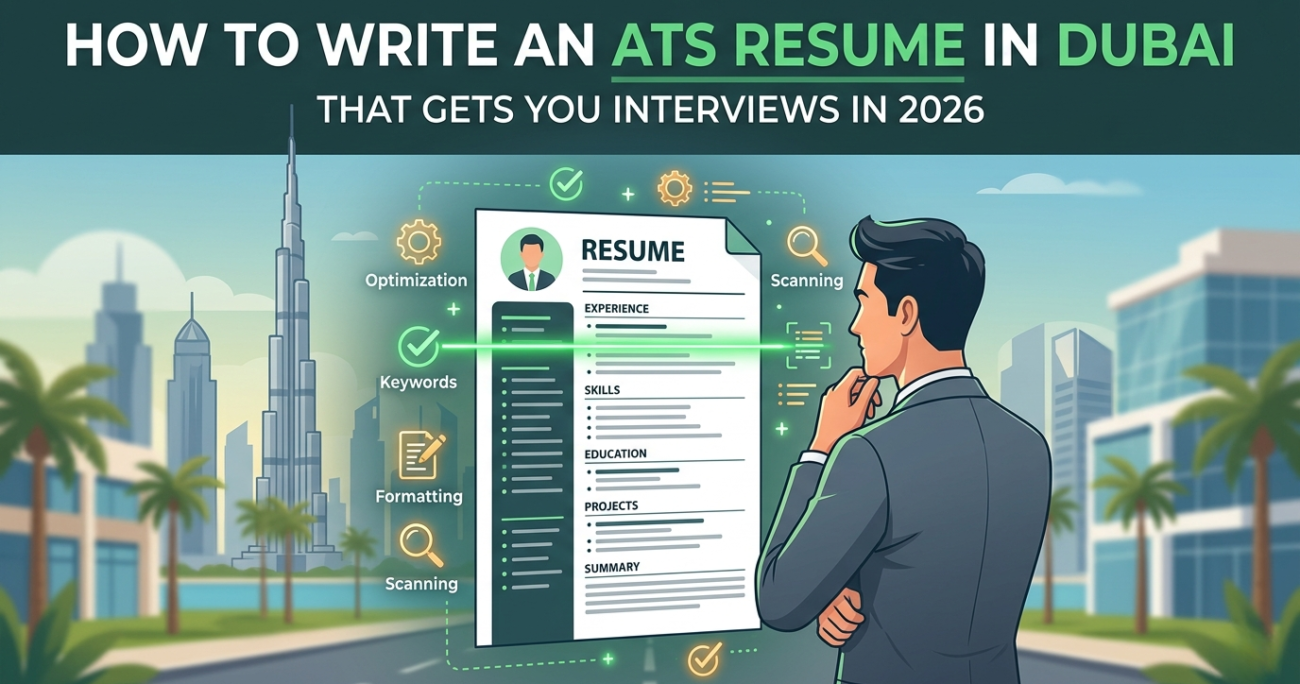
If you are applying for jobs in Dubai in 2026 but not receiving interview calls, the issue may not be your qualifications. In most cases, the problem is your resume format. Today, most employers in the UAE rely on Applicant Tracking Systems (ATS) to automatically scan and filter job applications before they ever reach a human recruiter. This means that even highly skilled candidates can be rejected simply because their resume is not optimized for ATS software. Understanding how to create an ATS resume in Dubai has therefore become essential for anyone serious about landing interviews.
An ATS, or Applicant Tracking System, is software used by companies to manage large volumes of job applications. It scans resumes for relevant keywords, evaluates formatting, and ranks candidates based on how closely their profiles match the job description. In Dubai’s highly competitive job market, where thousands of applicants may apply for a single position, ATS systems play a critical role in shortlisting candidates. This is why an ATS resume in Dubai must be carefully structured to ensure it is readable by these systems and aligned with employer expectations.
The importance of ATS optimization in Dubai cannot be overstated. Most large companies in the UAE use systems such as Workday, Taleo, SAP SuccessFactors, and Oracle ATS to manage recruitment. These systems automatically reject resumes that do not contain the right keywords or that include complex formatting such as tables, graphics, or multi-column layouts. As a result, candidates who rely on visually designed resumes often find themselves overlooked, even when they are well-qualified for the role. In such a competitive environment, having a properly structured ATS resume in Dubai is no longer optional but necessary for career growth.
A strong ATS-friendly resume starts with a simple and clean format. Many job seekers make the mistake of using overly designed templates that include icons, images, and multiple columns. While these may look visually appealing, they often confuse ATS software and lead to automatic rejection. Instead, a single-column layout with standard fonts such as Arial, Calibri, or Times New Roman is recommended. The goal is to ensure that the ATS can easily read and interpret every section of your resume without errors.
Another crucial factor in creating an effective ATS resume in Dubai is keyword optimization. ATS systems scan resumes for specific keywords that match the job description. For example, if a job requires skills such as project management, Excel, or team leadership, those exact terms should appear naturally in your resume. However, it is important to integrate these keywords in a meaningful way rather than simply stuffing them into the document. The most effective resumes are those that tailor content to each specific job application, ensuring maximum relevance.
The structure of your resume also plays an important role in ATS performance. A well-optimized ATS resume in Dubai typically includes clearly defined sections such as contact information, professional summary, work experience, education, skills, and certifications. These sections should follow a standard format so that ATS software can easily categorize the information. Creative or non-standard headings should be avoided because they may not be recognized by the system.
Your professional summary is one of the most important parts of your resume because it is often the first section scanned by both ATS software and recruiters. A strong summary should clearly mention your job title, years of experience, key skills, and industry relevance. For example, a marketing professional might describe themselves as a results-driven specialist with experience in digital marketing, SEO, and campaign management within the UAE market. This type of summary helps both ATS systems and recruiters quickly understand your profile.
The skills section of your resume should also be carefully optimized. Instead of listing vague qualities such as “hardworking” or “team player,” it is more effective to include specific technical and industry-related skills. These might include tools, software, certifications, or job-specific competencies that are directly relevant to the role. This increases the chances of your resume matching the keywords that ATS systems are programmed to detect.
Many job seekers in Dubai unknowingly make mistakes that lead to automatic rejection. One common issue is using visually complex resumes that ATS systems cannot read properly. Another is submitting a generic resume for every job application without customizing it for specific roles. Missing keywords from the job description is another major reason resumes fail ATS screening. In some cases, even the file format can cause problems, especially when non-compatible formats are used instead of standard DOCX or ATS-friendly PDFs.
To improve your chances of success, it is important to approach resume writing strategically. A well-structured ATS resume in Dubai should always be tailored to each job by carefully analyzing the job description and incorporating relevant keywords. The formatting should remain simple and consistent throughout, and the content should be clear, concise, and directly aligned with employer expectations. Testing your resume using ATS checker tools can also help identify potential issues before applying.
It is also important to understand how recruiters in Dubai evaluate resumes beyond ATS systems. Once your resume passes the initial screening, it is reviewed by a human recruiter who typically spends only a few seconds scanning it. This means your resume must not only be ATS-friendly but also easy to read and professionally presented. Employers in Dubai often look for candidates who demonstrate clear career progression, relevant experience in the UAE market, and strong industry-specific expertise.
In many cases, job seekers struggle to achieve this balance on their own. This is where professional resume writing services become valuable. A professionally written ATS resume in Dubai is designed to meet both ATS requirements and recruiter expectations. It ensures proper keyword placement, structured formatting, and a compelling presentation of your skills and experience. For candidates applying in competitive industries such as IT, finance, healthcare, and aviation, professional support can significantly improve interview chances.
In conclusion, creating an ATS-friendly resume is essential for anyone seeking employment in Dubai in 2026. The job market is highly competitive, and most companies rely on automated systems to filter candidates before human review. By focusing on clean formatting, keyword optimization, and job-specific tailoring, you can greatly increase your chances of passing ATS screening and landing interviews. If your resume is not optimized for these systems, you may be missing out on opportunities without even realizing it. A strong ATS resume in Dubai is not just a document—it is your gateway to career success in one of the world’s most competitive job markets.
FAQ'S
An ATS resume in Dubai is a CV designed to pass Applicant Tracking Systems used by employers in the UAE. It is formatted simply and includes relevant keywords so that software can easily scan and shortlist it for interviews.
Most companies in Dubai use ATS software to filter job applications before a recruiter sees them. If your resume is not ATS-friendly, it may get rejected automatically even if you are qualified for the job.
Yes, an optimized ATS resume in Dubai significantly increases your chances of getting interviews because it improves keyword matching, passes automated screening systems, and ensures recruiters actually see your application.
The best format for an ATS resume in Dubai is a clean Word document (.docx) or a simple PDF that does not contain complex designs. The layout should be single-column and easy for software to read.